
New study adds to the possibility of favorable conditions for life at Saturn’s moon Enceladus

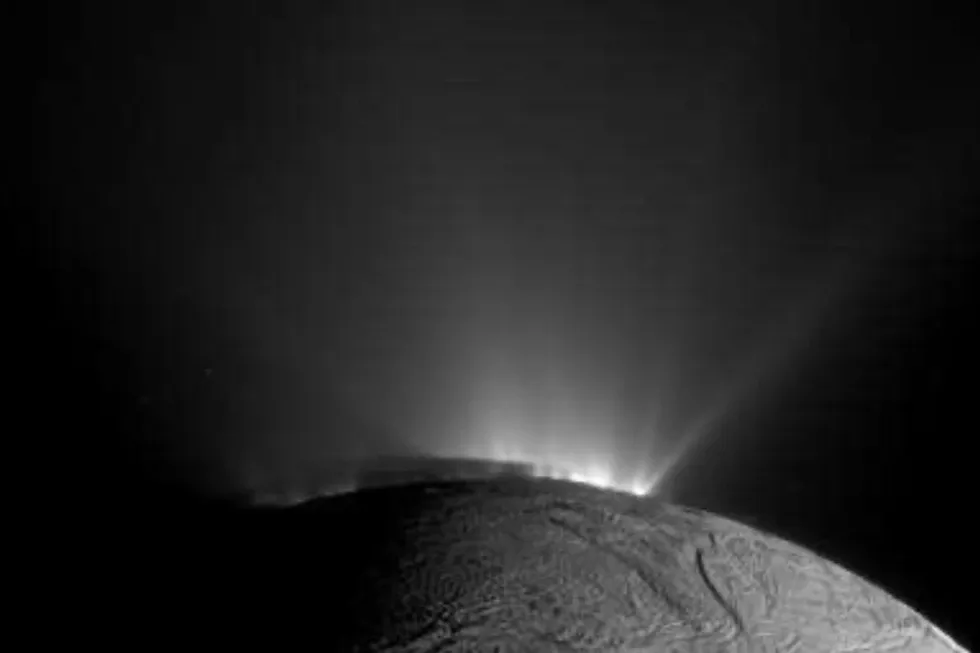
CAPE CANAVERAL, Fla. (AP) — Scientists have uncovered new types of organics in icy geysers spouting from Saturn’s moon Enceladus, bolstering the likelihood that the ocean world may harbor conditions suitable for life.
- Their findings, reported Wednesday, are based on observations made by NASA’s Cassini spacecraft in 2008 during a close and fast flyby of Enceladus.
- The small moon, one of 274 orbiting Saturn, has long been considered a prime candidate in the search for life beyond Earth because of its hidden ocean and plumes of water erupting from cracks near its south pole.
- While Enceladus may be habitable, no one is suggesting that life exists.
“Being habitable and being inhabited are two very different things. We believe that Enceladus is habitable, but we do not know if life is indeed present,” said the University of Washington’s Fabian Klenner, who took part in the study.

An international team decided to launch a fresh analysis of tiny grains of ice encountered as Cassini flew through the moon’s geysers. The grains were young compared with the much older geyser particles that ended up in one of Saturn’s outermost rings.
These new grains collided with Cassini’s cosmic dust analyzer at 40,000 mph (64,800 kph), faster than the old ones. The increased speed provided a clearer view of the chemical compounds present, the scientists noted.
Organic molecules already had been spotted in the old geyser grains, but their age raised questions as to whether they had been altered over the years by space radiation.
Scientists found some of the same molecules in the fresh grains, confirming they came from the moon’s underground sea, as well as new chemical compounds. The findings were published in Nature Astronomy.
An ice-encapsulated water world barely 310 miles (500 kilometers) across with a rocky core, Enceladus is suspected of having hydrothermal vents on its ocean floor, quite possibly like those in the Arctic. The moon’s jets of water vapor and frozen particles can stretch thousands of miles (kilometers) into space.
Read more from this journalist here.